
Bleeding Conifer Crust (Stereum sanguinolentum)
Good evening, friends,
This past Saturday* I met up with my new friend Nathan (founder of mushroomobserver.org) to look for mushrooms at the Four Ponds Conservation Area in Bourne, MA. He asked if I was looking for anything in particular, and while it’s not particularly the high season for mushrooms and expectations were tempered, I had heard whispers of a crust fungus that turns a vibrant red when bruised. Well lo and behold, this week’s mushroom is the bleeding conifer crust (Stereum sanguinolentum).
*Did I forget to put the SD card in my camera on Saturday so I had to go back on Sunday morning to get pictures? Sure did.

Fun Facts
The vibrant red discoloration was created when I scratched my thumbnail across the smooth surface of the mushroom (the fertile surface, the hymenium, where the spores are released), but the bruising did not occur on the hairy caps. The bruising is a chemical reaction that occurs when the cell walls of the mushroom are exposed to oxygen, but I couldn’t figure out the actual chemical produced. The red bruising fades to brown within half an hour.
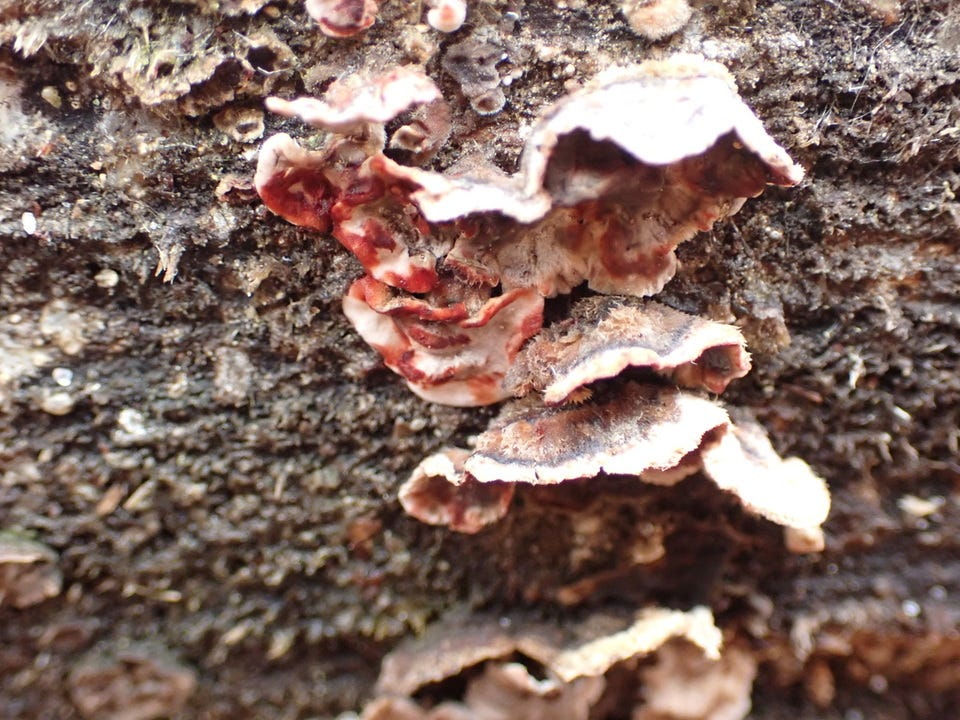
Stereum comes from the root ster- which meets “firm” or “solid”. The species epithet sanguinolentum comes from the Latin sanguis which means “blood” and refers to that aforementioned bruising. The suffix -lentum probably comes from the root -lentos which means “smooth, pliant” and relates to the texture of the fertile surface. The fresh mushrooms were quite rubbery so firm, smooth, and pliant are all apt descriptors.
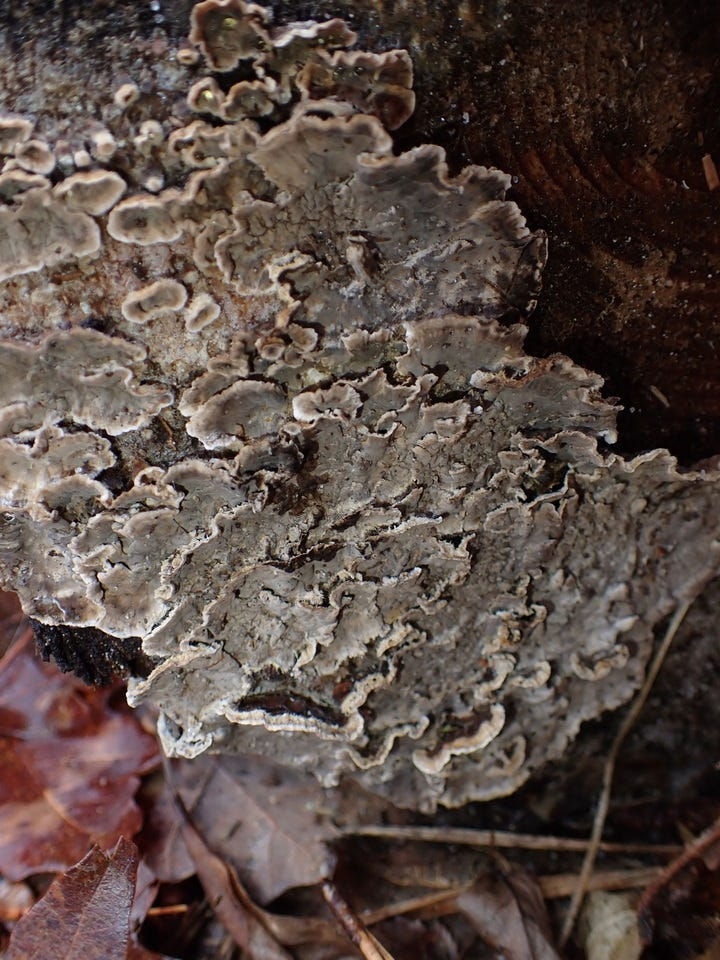
A study out of South Korea looked at 83 different fungi (that they cultivated in a lab) and determined that the crude extracts of S. sanguinolentum possessed the strongest antioxidant properties out of the bunch (Reference 1) . This mushroom grows as a crust and is hard to separate from the substrate, otherwise it would be up there with turkey tail and chaga in the antioxidant-rich medicinal mushrooms. This is probably a mushroom our friend Rich would have fun with.
Ecology
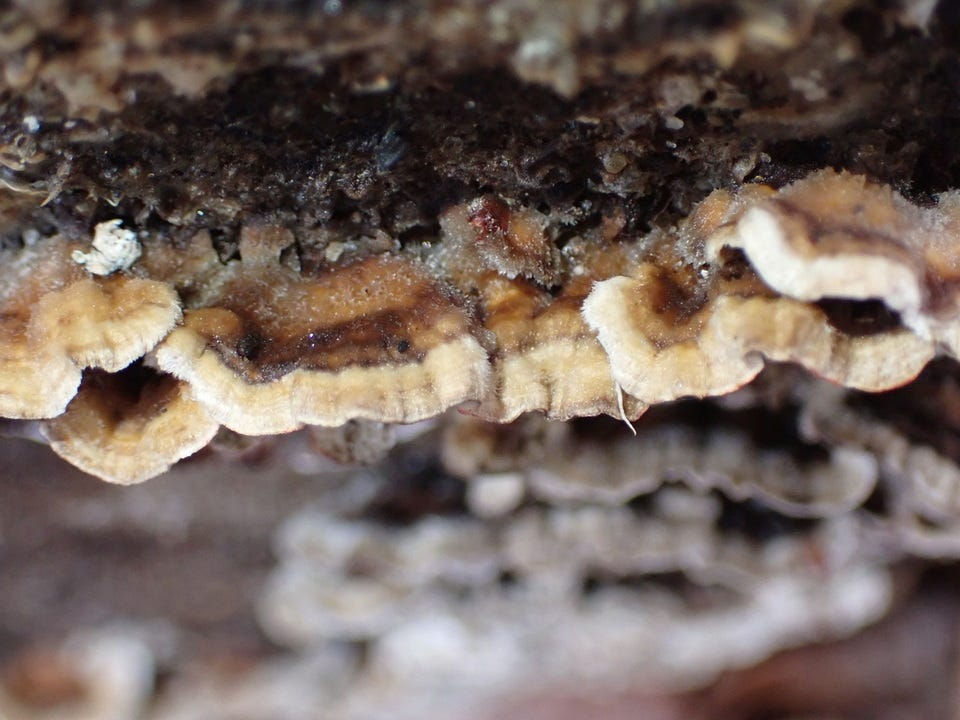
The fungus is both a decomposer (saprobic) and pathogen on conifer wood. Interestingly, it creates both a white rot and brown rot — most fungi are one or the other with the vast majority creating a white rot.
White rot vs brown rot is a matter of appetite. The white rot fungi prefer to eat the lignin in the plant cells, while the brown rot lean toward the cellulose and hemicellulose. All of these compounds help comprise the cell walls of the plant cells — that’s what these decomposition fungi like to eat. Perhaps the ability to produce all the different enzymes required for both white rot and brown rot digestion leads to the increased antioxidant capabilities for S. sanguinolentum.
As a pathogen the fungus can digest both the heartwood and sapwood of living conifers. The fungus rapidly colonizes dead or injured conifers and is quick to produce mushrooms after introduction to the wood.
A case study from a Norway Spruce plantation in New York found that poorly pruned trees had S. sanguinolentum growing all over them five years later (Reference 2). Decay was noticed in cross-sections of afflicted trees where the fungus creates a “red heart rot”. The mushroom turns red when bruised, but the living wood it digests also stains red — unclear if it’s due to the same compound in both cases.
S. sanguinolentum can be found on conifers across the northern hemisphere and in Australia. The wide distribution makes me think there is potential for a species complex (several genetically unique species based on geographic location) within this understudied crust. There is a similar species, Stereum gausapatum, that bruises red but grows exclusively on hardwoods, and almost always oaks.

April Events
4/19/2025 - Hyannis Country Gardens Mushroom Cultivation Workshop in Hyannis, MA. This just got added, there’ll be a link next week.
Last day of March, keep your wits about you tomorrow ;)
Aubrey
References:
Lee J, Hong JH, Kim JD, Ahn BJ, Kim BS, Kim GH, Kim JJ. The antioxidant properties of solid-culture extracts of basidiomycetous fungi. J Gen Appl Microbiol. 2013;59(4):279-85. doi: 10.2323/jgam.59.279. PMID: 24005177.
https://www.inaturalist.org/taxa/118104-Stereum-sanguinolentum