
A Questionable Encounter With a Man-on-Horseback - Tricholoma equestre
Good evening, friends,
Yesterday, the Cape Cod Mycological Society met in the Shawme-Crowell State Forest for quite a successful mushroom walk. We found black trumpets, which was quite a surprise for this time of the year because they’re typically a summer mushroom. Our hypothesis was that it was such a dry summer they weren’t able to grow until now (after we’ve finally had an abundance of rain), and it was better to fruit late in the fall than to miss a year of spore dispersal entirely.
We found a great diversity of mushrooms, including the Man-on-Horseback (Tricholoma equestre) below, which we’ll learn a little more about today.
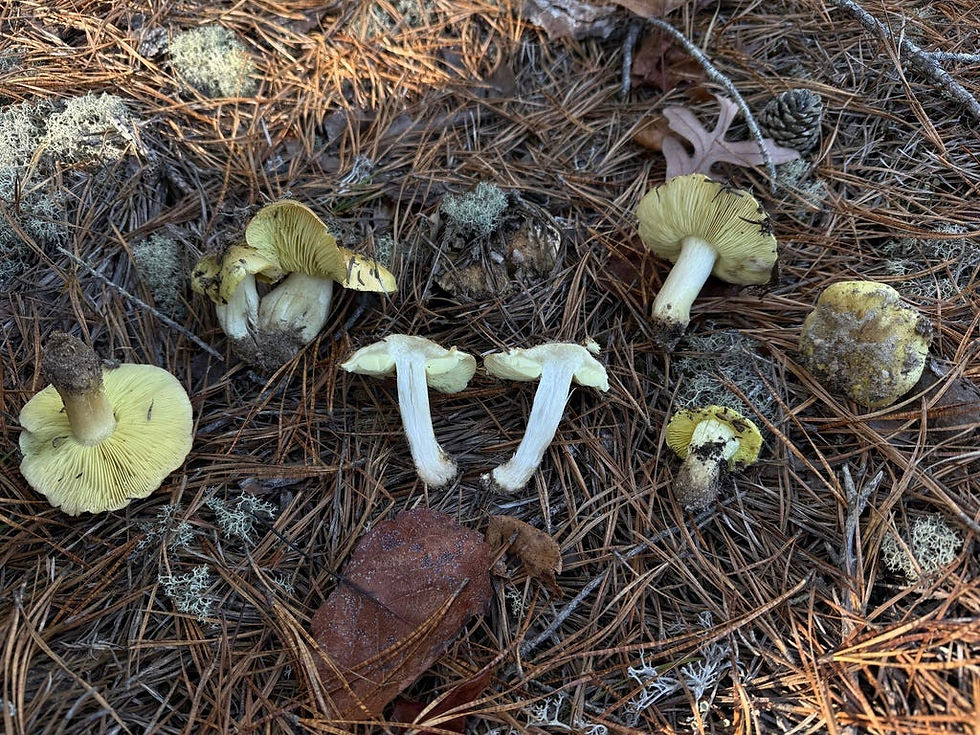
Don’t be fooled by the above picture. We found just a few yesterday, and a couple folks brought the few we did find back home to eat. They were noted to be a good edible, not as choice as their relative Matsutake, but a fairly subtle flavor that sautés nicely.
I had never eaten them and I was curious to try them. That’s when Rich said, “You know, if you’re looking for Tricholoma equestre, they’re everywhere at Breivogel”. He was referring to Breivogel Ponds Conservation Area, the home of the dye-ball (Pisolithus arenarius) from a couple weeks ago, and a preserve that is quickly becoming my favorite place to look for mushrooms. A small group of us decided at the end of yesterday’s walk to convene there early this morning, and our efforts on this cold, blustery morning were not in vain.
These mushrooms were fruiting in the hundreds (if not thousands) around young pitch pines in this recently restored ecosystem. We barely even got into the preserve as we just poked around the first few stands of trees on the periphery. We were there for under an hour and filled our baskets.

“Well how fun was that?” I thought, when I got home. This Mushroom Monday basically wrote itself. Let me learn a little bit more about this mushroom and get to writing.
One of the first descriptions I found listed the mushroom as “a common edible fungus that is considered to be toxic under certain conditions.” The paper noted how ingestion of the mushroom caused four separate cases of rhabdomyolysis in Europe (Reference 3). The next logical question is “What are those ‘certain conditions’ that cause rhabdomyolysis?” Well, no one really knows.
Alright, not exactly what I wanted to read. Particularly because my research occurred after I sautéed a couple and ate them in an omelet. My body is already playing catch-up after attending a friend’s bachelor party this weekend, the last thing I need is the breakdown of muscle tissue which releases myoglobin into the blood and can lead to potentially lethal kidney damage. I then found a follow-up study where researchers found this mushroom caused rhabdomyolysis in 42 mice (Reference 4). Oh boy, am I starting to sweat?
Fortunately, a little more reading revealed that the “toxicity” of this mushroom isn’t much different than the Leccinum vulpinum I wrote about a couple weeks ago. While the mushroom did cause rhabdomyolysis in mice, so did the choice edible Boletus edulis (Porcini in Italian, Cep in French, and a choice edible across the world). The researchers concluded the rhabdomyolysis brought on by both of these mushrooms was an “unspecific response and requires individual sensitivity and a great amount of ingested mushroom to manifest itself” (Reference 4).
If there’s any takeaway, it’s to eat a small portion of any wild mushroom you’re ingesting for the first time. The people who poisoned themselves all ate substantial amounts, amounts that are difficult to fathom (one man ate one liter of these mushrooms three times a day for a week straight, another ate them each day as a main meal for over a month). Start small, don’t overindulge.

Etymology
The etymology of Tricholoma comes from the Greek tríchos which means hair, and lôma, which means fringe. The name suggests these mushrooms have a hairy edge of their cap, but most of the time I see the hair on top of the cap, not on the margin, and it gets matted down rather quickly.
To understand Equestre we start with the Latin equus which means horse. Swap an “e” for a “u” and eques means “horseman” or “rider”. We add the -tre suffix and equestre means “pertaining to horsemen”. However, it can also be interpreted as “knightly”, or “pertaining to knights”. Mushrooms in the genus Tricholoma are already referred to as “knights”, so that would make this mushroom the knightliest knight, or knight².
The mushroom was first described as Agaricus equestris by Carl Linnaeus in 1753, but his rationale for the horse moniker appears to be lost to history. There are, however, a lot of different ideas floating around. It could relate to the saddle-like shape of the mushroom’s cap, which seems like a stretch. The hypothesis I find the most appealing is that the yellow color of the mushroom is consistent with the bright yellow color worn by some knights/cavalry. There’s also an idea that these mushrooms were served at the knights’ table and were an edible mushroom that denoted nobility.

Ecology
The fungus is ectomycorrhizal and wraps around the tips of pine trees (these were growing with young pitch pine, Pinus rigida). One study noted the fungus produced compounds in the mushroom that promote plant root growth in lettuce, but also inhibited hypocotyl growth (the growth of the leading stem). These compounds were also found in the mushroom, not the mycelium of the fungus, so it’s hard to know what to make of this information.
The mushrooms can be found growing with pines in nutrient-deficient soils across the northern hemisphere, and they typically fruit in the fall. There are several physically identical but genetically distinct species that comprise a T. equestre species complex. A white stipe, yellow gills that are notched (notched gills drop a millimeter or two before they attach to the stipe), and a yellow to olive green cap are all characteristics of the complex. They don’t have a strong odor nor taste.

Upcoming Talk
This Friday at 6:30PM. I’ll be in Manhattan to give a talk on burn mushrooms of the northeast for the New York Mycological Society. It’s a more thorough look at the mushrooms I talked about at the NYMS Fungus Fest (plus others that I couldn’t fit on the poster board). Hope to see you there :)

Well, it’s now been twelve hours and my muscles haven’t disintegrated. I’ll take that as a sign that I don’t have an individual sensitivity and I’ll eat the rest. Possibly with fava beans and a nice chianti.
New moon on Thursday,
Aubrey
References
Kuo, M. (2024, January). Tricholoma equestre. Retrieved from the MushroomExpert.Com Web site: http://www.mushroomexpert.com/tricholoma_equestre.html
Laubner G, Mikulevičienė G. A series of cases of rhabdomyolysis after ingestion of Tricholoma equestre. Acta Med Litu. 2016;23(3):193-197. doi: 10.6001/actamedica.v23i3.3385. PMID: 28356809; PMCID: PMC5287993.
Nieminen P, Mustonen AM, Kirsi M. Increased plasma creatine kinase activities triggered by edible wild mushrooms. Food Chem Toxicol. 2005 Jan;43(1):133-8. doi: 10.1016/j.fct.2004.09.002. PMID: 15582205.
Qiu W, Kobori H, Wu J, Choi JH, Hirai H, Kawagishi H. Plant growth regulators from the fruiting bodies of Tricholoma flavovirens. Biosci Biotechnol Biochem. 2017 Mar;81(3):441-444. doi: 10.1080/09168451.2016.1249453. Epub 2017 Jan 24. PMID: 28114857.